By THOR CHRISTENSEN
The Dallas Morning News
The rules of romance say if you love something, set it free. But the rules of rock tell you to smash it to smithereens.
"Taking a guitar you love and wrecking it is incredibly exciting. It's the ultimate statement of anarchy," says Joe Perry of Aerosmith.
"You're trying to shatter the audience's mind, so why not start with the tangible: the guitar?" says ZZ Top's Billy Gibbons.
Guitar smashing is a time-honored sacrament in rock 'n' roll used by everyone from Jimi Hendrix to Kurt Cobain to today's bands like the Vines. It's easy to see why. For the smasher, it's pure catharsis. For the fan, it's the vicarious thrill of watching stuff get destroyed - a demolition derby with power chords.
But 40 years after Pete Townshend of the Who annihilated his first electric guitar, the ritual still polarizes the rock world.
"To me, it's show biz. I don't see much value to it, to be honest," says Eric Clapton.
"I once smashed a guitar onstage in pure rage because I got an electric shock that scared the living daylights out of me. But as soon as I did it, I regretted it. It was my favorite guitar, and even after I repaired it, it was never the same."
"I've never even tried it," says Carlos Santana. "I'll sacrifice other things, but not my guitar."
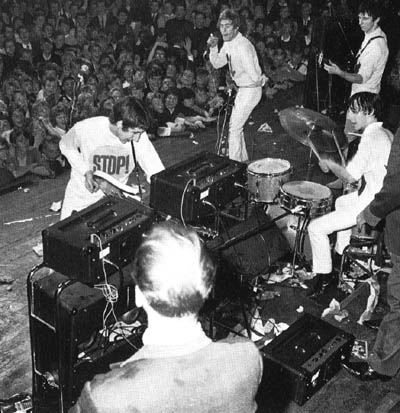
Like so many inventions, guitar demolition began as an accident. In 1964, during a show at London's Railway Station nightclub, Townshend began waving and jerking his electric Rickenbacker to try to make it stop whistling. He banged it on the club's low ceiling, impressing one fan so much he asked the guitarist to do it again in the second set.
When he did, the guitar snapped in half, stunning both the crowd and Townshend.
"I had no recourse but to look as though I meant to do it, so I smashed the guitar and jumped all over the bits ... it gave me a fantastic buzz," he said in the Who biography "Before I Get Old."
The London press got wind of the smash-up and dispatched photographers. Thrilled by the notoriety, Townshend began obliterating guitars regularly, telling reporters it was his statement of antimaterialism and comparing himself to German autodestruct artists who built sculptures designed to collapse.
"To me, it wasn't violence or random destruction," Townshend said. "It was art."
The idea spread, and in the 1966 drama "Blowup," director Michelangelo Antonioni captured Jeff Beck of the Yardbirds smashing his ax and hurling the pieces to the crowd, which fought over them like jackals.
Soon after "Blowup" premiered, a rising young guitar hero named Jimi Hendrix also started bashing his instrument onstage. An angry Townshend confronted him backstage at the Monterey Pop Festival in 1967 and demanded he stop stealing his act.
But Jimi wisely refused to budge. Today, pictures of Hendrix setting his Strat on fire and breaking it to shards are some of the most famous images in rock history.
"When I saw Hendrix do that at Monterey, it was like a supreme sacrifice from out of the Bible," says Santana. "It was very spiritual and voodoo-like, and I think he was taking music all the way back to Africa ... I didn't get the same feeling from Peter Townshend. He was more like a brat throwing a television."
By the time both acts got to Woodstock in '69, hordes of young guitarists were already emulating them, including a Dallas teenager named Jimmie Vaughan.
"It was so cool because it was so wrong," says Vaughan, whose band, the Chessmen, opened for Jimi Hendrix at SMU in 1968. "We couldn't afford to break our own guitars, so we'd get a lousy one and break it onstage just to see if we could do it."
Other fledgling smashers made the mistake of using expensive guitars, which didn't splinter so easily.
"Have you ever tried smashing a baseball bat against a cement wall?" asks Aerosmith's Perry. "That's what it's like trying to smash a Stratocaster - it doesn't give. But you're so loaded with adrenaline, you just keep doing it, even though it hurts."
The novelty wore off in the early '70s, but the act blossomed again during the punk era.
Paul Simonon of the Clash is seen crushing a bass guitar on the cover of "London Calling" (1979). And in the '90s, alternative rockers such as Sonic Youth and Pearl Jam fractured their guitars for audiences too young to remember Hendrix.